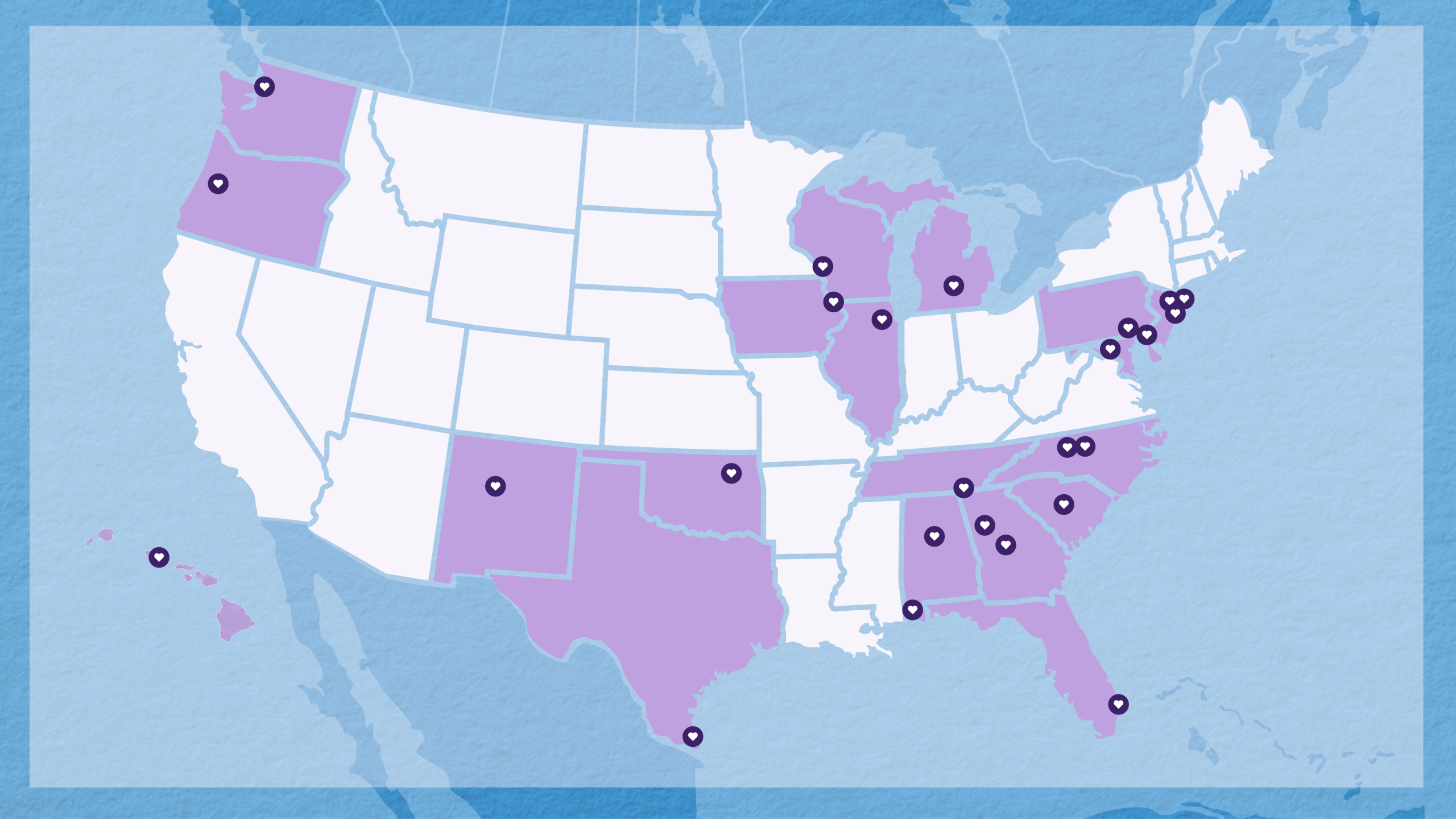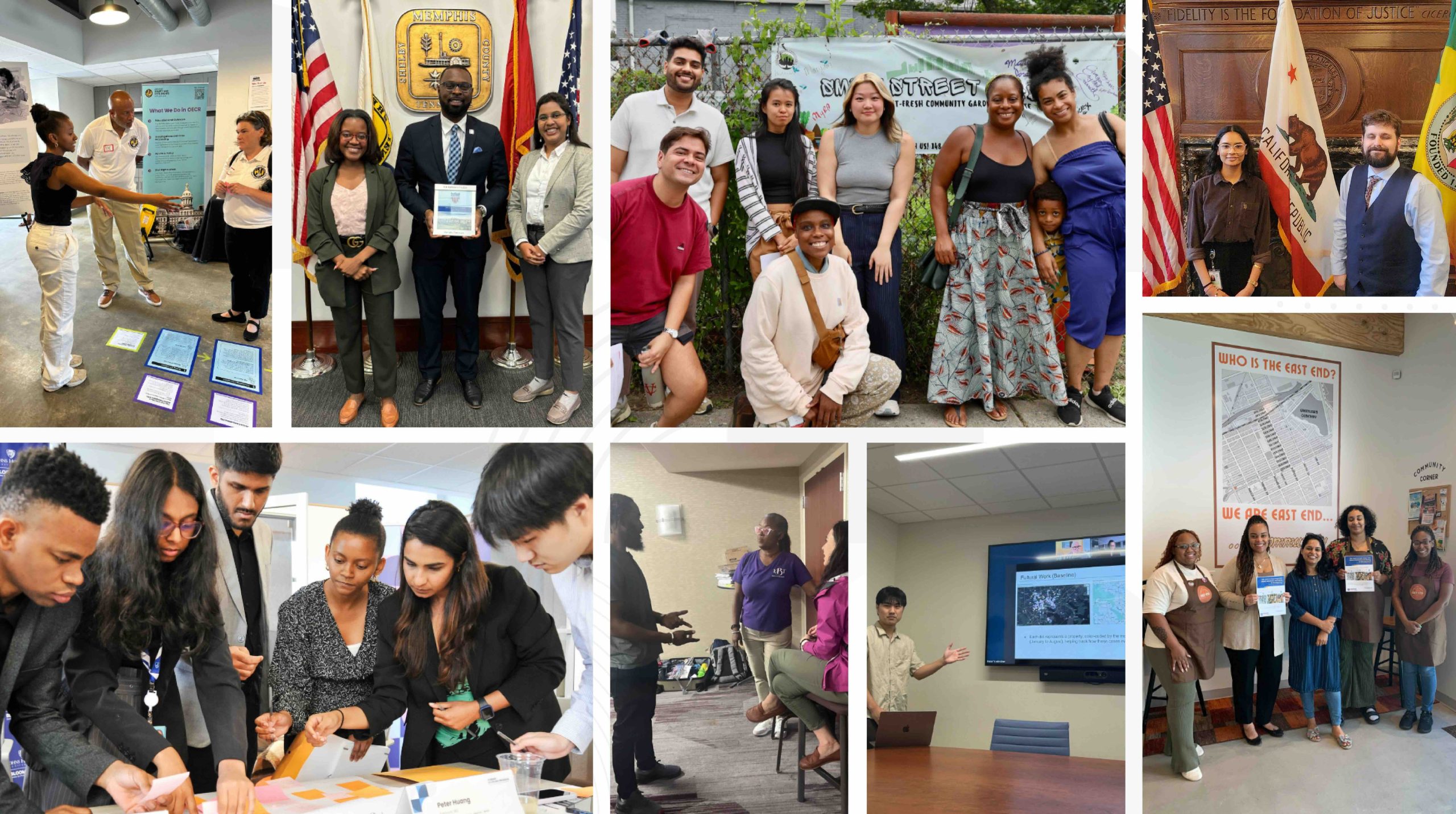
In 2025, 19 graduate students selected from across Johns Hopkins University were embedded in city hall innovation teams across the United States to address urgent policy challenges using cutting-edge innovation methods. As part of the Summer Scholars program at the Bloomberg Center for Public Innovation at Johns Hopkins University, these students participated in an immersive 10-week placement in which they applied their academic training, knowledge, and creativity to address public problems alongside residents and city leaders.
In 2026, Summer Scholars will be embedded in innovation teams and mayors’ offices throughout the United States to work on city-led projects in Atlanta, Baltimore, Boston, Cleveland, Dayton, Gary, Memphis, Montgomery, Nashville, Newark, Raleigh, and Port St. Lucie, as well as with the State of Maryland, delivering tangible outcomes through policy analysis, data-driven research, community engagement, prototyping, and storytelling. Learn more and apply at publicinnovation.jhu.edu/summer-scholars/.
The 2025 Summer Scholars—students from the Johns Hopkins Bloomberg School of Public Health, Carey Business School, the School of Advanced International Studies, and the Whiting School of Engineering—gained on-the-job experience and deployed their skills to deliver meaningful impact on issues including sustainability, waste reduction, permitting, housing, and public safety. Students conducted research, analyzed data and operations, and employed storytelling to advance solutions inside city governments and with residents, providing critical public innovation capacity in a number of ways that include:
Fixing Permitting in Oakland
Ira Sharma | MBA candidate, Johns Hopkins Carey Business School | Oakland, California
Joining Oakland’s Innovation Team (i-team), Ira Sharma used a human-centered design approach to assess problems in the city’s permitting system that were leading to resident and business frustration, project delays, and an increase in dangerous unpermitted work. Sharma conducted interviews and focus groups, mapped the permitting process, and examined other cities’ practices to propose eight principles and a framework to overhaul the city’s permitting process. Key inputs to her recommendations were design workshops, which she planned and implemented, that included convening a cross-departmental mix of city staff and leaders for the first time and hosting the city’s first community ideation session dedicated to permitting.
“Working with the City of Oakland … showed me that my real strength is people, creativity is the strategy that I use, and that there can be impact at a very large human scale. Design, business, and policy can work together to change everyday lives for people,” said Sharma.
Turning Sustainability Goals Into Measurable Action in Newark
Anish Mudaliar | MS candidate in Engineering Management, Johns Hopkins Whiting School of Engineering | Newark, New Jersey
Working in Newark’s Office of Sustainability, Anish Mudaliar helped advance the city’s environmental justice efforts by using his skills in data analytics and evaluation to improve the city’s monitoring of sustainability programs aimed at addressing urban heat islands and energy burden for residents.
Mudaliar’s contributions included designing standardized environmental and social cohesion metrics for
Love Your Block, Newark!, a program that funds small, resident-led community revitalization projects. He created an evaluation framework for Cool Roofs Newark, a heat mitigation program; assessed gaps in clean energy data; and proposed a grid-readiness strategy to support the city’s transition to solar energy and its deployment of electric vehicles. Invited to present at the Newark Sustainability Unconference, he showcased an interactive data dashboard that translated community input on extreme heat, air quality, and energy into data-driven updates to the city’s Sustainability Action Plan.
As a research assistant with the Bloomberg Center for Public Innovation at Johns Hopkins during the 2025-2026 academic year, Mudaliar continues to contribute to the city’s measurement and evaluation capacity. “Working in Newark is an amazing opportunity to translate my training in engineering management into immediate real-world impacts,” he said.
Humanizing Accountability in Baltimore’s Police Department
Ashauna Lee | MSPH candidate, Johns Hopkins Bloomberg School of Public Health | Baltimore, Maryland
Ashauna Lee saw storytelling efforts as key to supporting Baltimore residents and police officers. She spent her summer with Baltimore’s i-team, which is working to address police staff shortages that negatively impact public safety and stress city finances. On the i-team, Lee learned about the factors that lead to police officer attrition and used her research and communication skills to humanize the police accountability process and foster greater community understanding of the officer experience. She helped organize a Community of Practice public meeting in Baltimore’s Upton neighborhood, designed and led an interactive simulation on officer accountability, and hosted a brainstorming session on increased community leadership to improve police-community relations.
By humanizing the individuals involved and affected—including officers, community members, public integrity investigators, and administrators—Lee’s Community of Practice fostered empathy and a deeper understanding of systemic barriers to change.
“My academic training from the Johns Hopkins Bloomberg School of Public Health in qualitative research and human-centered design allowed me to effectively gather, synthesize, and cultivate qualitative stories that represented an array of different lived experiences and resonated with key stakeholders and change-makers,” said Lee.
Making Household Climate Action Clear Through Storytelling in Boston
Krithiga Narayanan | MAIR candidate, Johns Hopkins School of Advanced International Studies | Boston, Massachusetts
In Boston, Krithiga Narayanan worked in the Mayor’s Office of New Urban Mechanics to increase resident participation in recycling and organic composting. Her landscape analysis and user research revealed that resident confusion and a lack of awareness about city services and recycling were key barriers. Narayanan addressed these gaps by creating short, accessible, and popular tutorials on Boston’s Project Oscar public compost drop-off bins, the city’s Waste Ambassador program, and recycling at home. Her work aimed to make it easier for residents to adopt sustainable behaviors by translating household-level climate-action and waste-reduction systems into relatable, human-centered stories.
“In public innovation, residents are at the heart of the solution,” said Narayanan. “Relatable storytelling can be a bridge so that people can see themselves in the solution. My role in Boston was to translate citywide systems into simple, human stories; support community-led engagement; and invite residents to be part of change. This makes action on sustainability and climate resilience feel possible and shared.”
Are you ready to dive into real-world public innovation projects and make a difference in city hall? Learn more about joining the 2026 cohort of Summer Scholars at https://publicinnovation.jhu.edu/summer-scholars/.