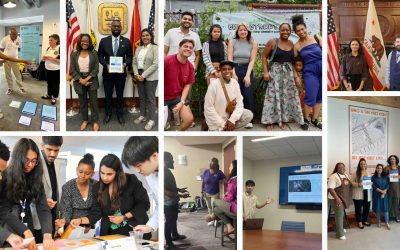
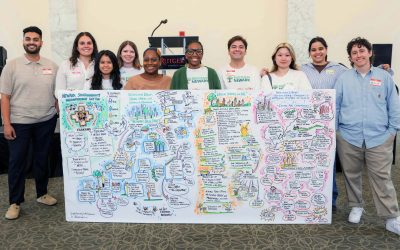
In different contexts and cities around the world, public servants are proving that innovation methods produce results. To build their practices and sharpen their skills, 155 public innovators from 84 cities across 15 countries gathered in Baltimore in October 2025 to participate in the inaugural Public Innovators Network Summit, hosted by the Bloomberg Center for Public Innovation at Johns Hopkins University, with generous support from Bloomberg Philanthropies. Through panels, workshops, and peer connections, attendees explored actionable ways to build a culture of innovation in city halls, sustain that innovation capacity over time, engage young residents as policymaking participants, and develop innovation portfolios that deliver meaningful change in the lives of people.
Across sessions, city leaders shared insights on how they are building structures to support innovation and its impact now and for the long term.
Here are insights from the public innovation front lines:
Build Portfolios that Balance Speed and Long-Term Change
How do you make sure innovation survives political turnover and becomes embedded in the way a city operates?
The Summit opened with a discussion among innovation directors Kristie Chin (Philadelphia, Pennsylvania), Kyle Patterson (Boise, Idaho), Angela Reyes (Bogotá, Colombia), and Leah Tivoli (Seattle, Washington), moderated by Carol Coletta, Bloomberg Public Innovation Fellow. The group shared how they and their peers balance responding to urgent needs—like lowering crime rates and increasing access to housing—with driving long-term change through their leadership of innovation teams and guidance from the Path to Public Innovation.
Their common insight was that innovation benefits from a portfolio approach: advancing complementary initiatives simultaneously to manage risk, show early impact, and keep stakeholders on board.
“We had that portfolio approach right from the beginning, a middle-out approach, bringing together 10 different departments to identify our challenges, work with communities, allocate resources, and operationalize solutions,” said Chin, Innovation Team Director for the City of Philadelphia. “The portfolio allows us to move both fast and slow. We can deliver wins that contribute to our long-term priorities of safer, cleaner, greener neighborhoods with opportunity for all.”
Philadelphia’s “Community Investment Portfolio” includes cross-cutting projects that connect work on affordable housing and home repair with efforts to redevelop vacant lots and support workforce opportunities. By viewing these efforts as interlocking investments, the city advances short-term progress—like removing debris and creating green spaces—on vacant lots while setting up systems to scale improvements across thousands more.
Pair Quick Wins with Strategy to Sustain Momentum and Earn Trust
Similarly, Tivoli, Director of Innovation and Performance for Seattle, described how the city’s innovation work over the past 10 years has experienced success by blending quick wins with long-term strategy.
In the Little Saigon neighborhood, the city’s i-team used innovation methods to revitalize a five-block area that struggled with vacant properties and safety issues. The team’s “stabilize, activate, invest” model produced early wins in the neighborhood, including a 20% year-over-year decrease in 911 calls, documented declines in drug overdoses, and improved public perception of safety.
“Five blocks, 10 businesses, 30 lives,” Tivoli shared. “A quick win is baked into our model for long-term innovation. Set a goal and get people to rally around it. That’s how you can show a quick win, then leverage it to build momentum for your bigger goals.”
Documented wins like these demonstrate that interventions and prototypes developed through the innovation process support cities in making progress on tough challenges.
Center Youth in Leadership, Policy, and Co-Creation
Taking a portfolio approach and stacking quick wins to snowball momentum are not the only ways to earn buy-in and sustain innovation. In a panel discussion led by Kali-Ahset Amen, Civic Engagement Director at the Bloomberg Center for Public Innovation at Johns Hopkins, city leaders from Reykjavik, Guatemala City, and Baltimore illustrated the meaningful impact of engaging youth in policy creation—and the long-term foundation that it lays for sustained innovation and civic participation.
In Guatemala City, where more than half the population is under the age of 26, Griscelda Cruz, Director of Environment for Guatemala City, and her team invited young people to co-create environmental solutions as part of their efforts to advance the city’s sustainability agenda. The city recognizes 160 youth as “environmental ambassadors,” both an honor and a responsibility for youth who lead projects ranging from environmental education programs in schools to conducting a detailed census of tree species in a municipal forest. Through this effort, the city has created a resident-led movement that deepens civic pride, informs policymakers through on-the-ground environmental work, and advances the city’s sustainability priorities.
“It’s a win-win,” said Cruz. “The city gains action and ideas, and young people gain the experience they need to shape their futures.”
In Baltimore, young people serve as co-creators with the city’s i-team as they work to address critical challenges through “Youth Co-Design Labs.” Participants in the Labs identified the need for and drove the testing of a program to overcome the time and cost obstacles posed by a driver’s license requirement for young, aspiring police cadet applicants. The resulting prototype—a Driver’s License Academy that supports recruits through the process of obtaining a driver’s license in Maryland—spurred a 300% increase in police onboarding and new philanthropic investment to continue the academy.
“If we are going to solve longstanding issues like housing and public safety, young people have to be at the table—and at the head of the table,” said Terrance Smith, director of Baltimore’s i-team in the Mayor’s Office of Performance and Innovation. “Shaping the future—especially when addressing large-scale, persistent problems—makes engaging youth non-negotiable.”
In Reykjavik, where the i-team partnered with residents to redesign school support systems to provide efficient, targeted support to students in need of specialized services, city leaders know they can only address a problem when they have the direct input of the people experiencing it.
Arna Ýr Sæversdottir, Head of Service and Digital Transformation for the City of Reykjavik, recognizes that failing to engage youth “leaves out a big chunk” of the range of possible solutions to challenges; including youth perspective is a must. “We have to always apply this innovation method, this way of working,” she said.
For Reykjavik, collecting direct input included designing an interactive crafting activity where children used beads of varying colors and shapes to visually represent how their school experience feels (see image).

Public innovation leaders, including those who serve as i-team directors, chiefs of staff, and civic designers, are actively making and delivering on commitments to work across institutional silos, access meaningful data about the root causes of problems, and do the ambitious work of finding solutions, building public trust, and improving residents’ lives.
“What our Public Innovation Network members demonstrate is that city halls can serve their residents creatively, with empathy and ambition,” said Francisca Rojas, Executive Director of the Bloomberg Center for Public Innovation at Johns Hopkins. “The insights participants shared with each other at the Public Innovators Network Summit, and the innovation strategies, resources, and connections the Network provides, help public servants address challenges and opportunities in ways that place residents at the center and drive meaningful impact.”
A Network for Innovation Leaders at Work on the Front Lines
The inaugural Summit was the first in-person event and one of more than 30 learning experiences for members of the Public Innovators Network—which has grown to almost 2,500 local government leaders since 2022. The Network welcomes public servants who share a commitment to using innovation, data, collaboration, and resident engagement to deliver exceptional results for residents.
Apply to join at https://publicinnovation.jhu.edu/network/.